
Farkle Dice Game Rules
Your game night just got a whole lot more exciting! Farkle is that perfect dice game that brings out everyone’s competitive side while keeping things light and fun. Whether you’re hosting a family gathering or looking for something to entertain the kids on a rainy afternoon, this classic game delivers every single time.
Parents love Farkle because it’s easy to learn but tricky to master, and kids get hooked on the thrill of pushing their luck for just one more roll. Teachers swear by it for math practice disguised as pure fun. You only need six dice and a scoresheet to get started, making it the ultimate portable party game that works anywhere from your kitchen table to a camping trip.
Ready to become the Farkle champion of your household? Let’s break down everything you need to know about Farkle dice game rules and scoring so you can start rolling those dice with confidence!

What You Need to Play Farkle
Farkle keeps things beautifully simple. Grab six standard dice (any color you like), some paper for scoring, and pencils for everyone playing. That’s it! You can play with anywhere from two to eight players, though four to six tends to be the sweet spot for maximum fun and manageable game time.
Some families love using a dedicated Farkle scorepad, but honestly, any piece of paper works perfectly fine. Just make sure everyone can see the score clearly because those points add up fast, and you’ll want to keep track of who’s winning!
Basic Farkle Dice Game Rules
The goal of Farkle is simple: be the first player to reach 10,000 points. Sounds easy enough, right? Here’s where it gets interesting. On your turn, you roll all six dice and look for scoring combinations. You must set aside at least one scoring die, then decide whether to keep rolling the remaining dice for more points or stop and bank what you’ve earned.
The catch? If you roll and don’t get any scoring combinations, you “Farkle” and lose all the points from that turn. It’s this push-your-luck element that makes Farkle absolutely addictive. Do you play it safe and bank 300 points, or risk it all for that big score?
How to Start Your Turn
Starting Your First Turn
- Roll all six dice on your turn.
- Look for scoring combinations and set aside at least one scoring die.
- Add up the points from your scoring dice.
- Decide whether to roll the remaining dice or stop and bank your points.
- If you roll again and score, add those points to your turn total.
- Keep going until you stop voluntarily or Farkle.
The Farkle Rule
When you roll dice and get zero scoring combinations, you’ve “Farkled.” This means you lose all points accumulated during that turn (not your total game score, just that turn’s points). Your turn ends immediately, and play moves to the next person. This is why knowing when to stop rolling becomes such a crucial strategy!
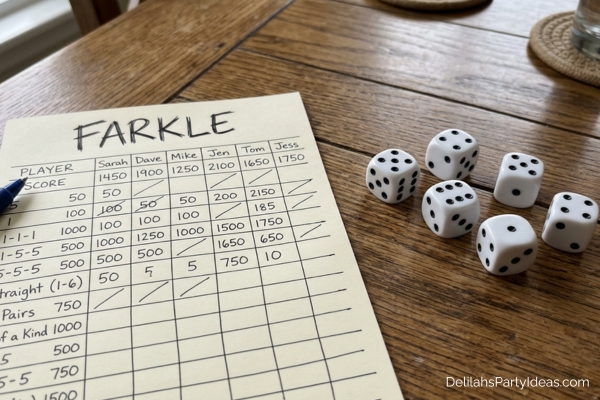
Farkle Scoring Combinations
Understanding the scoring system is key to mastering Farkle. Some combinations are worth way more than others, and recognizing the valuable patterns quickly will give you a huge advantage. Here are all the ways to score points in Farkle.
Individual Dice Scoring
Single 1s are worth 100 points each, and single 5s are worth 50 points each. These are your bread and butter scoring dice. All other individual dice (2, 3, 4, 6) are worth zero points on their own. This makes 1s and 5s incredibly valuable, especially when you’re trying to avoid a Farkle!
Three-of-a-Kind Scoring
When you roll three dice showing the same number, you hit the jackpot! Three 1s are worth a whopping 1,000 points (not 300 like you might expect). Three 2s, 3s, 4s, 5s, or 6s are each worth 100 times that number. So three 2s equal 200 points, three 3s equal 300 points, and so on.
Four, Five, and Six of a Kind
Roll four of the same number? Double the three-of-a-kind value! Five of a kind doubles it again, and six of a kind doubles it one more time. Four 3s would be 600 points, five 3s would be 1,200 points, and six 3s would be 2,400 points. These combinations don’t happen often, but when they do, they’re game-changers.
Straight Scoring (1-2-3-4-5-6)
Rolling a straight (one of each number from 1 through 6) in a single roll is worth 1,500 points. It’s rare and exciting when it happens! This is one of the highest single-roll scores you can achieve.
Three Pairs
Getting three pairs in one roll (like 2-2, 4-4, 6-6) scores you 1,500 points. This is another fantastic scoring combination that can really boost your game. Any three pairs count, regardless of which numbers they are.
Advanced Farkle Scoring Rules
Once you’ve got the basics down, these advanced rules will help you maximize your scoring potential and avoid common mistakes that trip up new players.
Hot Dice Rule
When you use all six dice for scoring in a single turn, you’ve got “hot dice.” This means you get to roll all six dice again and continue building your turn total. Hot dice can lead to absolutely massive scoring turns if luck is on your side, but remember, you can still Farkle on subsequent rolls!
Minimum Scoring Rule
Most Farkle variations require you to score at least 500 points in a single turn before you can start banking points toward the 10,000-point goal. Until you hit this threshold, any points you score don’t count toward your running total. This rule prevents players from inching forward with tiny scores.
Winning Rule
When someone reaches 10,000 points, every other player gets one final turn to try and beat that score. This keeps the game exciting right until the very end! The player with the highest score after everyone has had their final turn wins the game.
Tips for Playing Farkle Successfully
Know when to quit: The biggest mistake new players make is getting greedy. If you’ve scored 800 points in a turn, seriously consider banking them rather than risking a Farkle.
Count your dice carefully: Always double-check that you have the right number of dice before rolling. It’s easy to lose track, especially during exciting hot dice rounds.
Learn the scoring by heart: The faster you can spot scoring combinations, the quicker you can make smart decisions about which dice to keep and which to re-roll.
Watch other players’ scores: If someone is close to 10,000 points, you might need to take bigger risks to catch up. Adjust your strategy based on the game situation.
Practice the 500-point rule: Remember that you need 500 points in a single turn before you can start banking. Plan your first few turns accordingly!
Fun Farkle Variations to Try
Speed Farkle
Set a timer for each turn (try 60 seconds) to keep the game moving quickly. This variation is perfect for larger groups or when you want a more energetic game night. The time pressure adds a whole new layer of excitement to decision-making!
Team Farkle
Divide players into teams of two and let teammates consult on strategy decisions. One person rolls while the other gives advice on whether to continue or bank points. This variation is fantastic for mixed-age groups where kids can team up with adults.
High-Stakes Farkle
Raise the winning score to 15,000 or 20,000 points for a longer, more strategic game. This gives players more opportunities to make comeback plays and adds extra tension to every decision.
Mercy Rule Farkle
If a player Farkles three times in a row, they automatically get 500 points to prevent anyone from falling too far behind. This keeps everyone engaged and prevents frustrating losing streaks that can kill the fun.
Farkle has been bringing families and friends together for decades because it perfectly balances luck and strategy in the most delightful way. Once you start playing, you’ll find yourself saying “just one more game” over and over again. Get ready for some serious fun and maybe a little friendly competition around your table!