Games for Seniors with Dementia
Planning activities for a loved one with dementia can feel overwhelming, especially when you want something that’s genuinely enjoyable and not just a way to fill time. The good news? The right games can do so much more than entertain. They can encourage conversation, and bring real moments of fun. Whether you’re a caregiver, a family member, or a staff member at a memory care facility, these games for seniors with dementia are fun, gentle, and easy to adapt.
Dementia affects everyone differently, so the key is choosing activities that match your person’s current abilities and interests. Some people light up at music-based games while others love sorting through familiar objects. There’s no one-size-fits-all approach, and that’s actually kind of freeing. You get to experiment and find what makes them smile.
Below you’ll find a mix of sensory, cognitive, social, and movement-based games that work beautifully for seniors living with dementia. Let’s find their favorites!
Memory and Recognition Games for Seniors with Dementia
Games that tap into long-term memory are often the most rewarding for people with dementia. Long-term memories tend to stay intact much longer than short-term ones, so these activities can feel wonderfully familiar and confidence-boosting.
Photo Reminiscence Cards
Gather a collection of photos from the person’s past, old family pictures, images of familiar places, or photos of things they loved like cars, animals, or famous faces from their era. Sit together and look through them, asking gentle questions like “Does this look familiar?” or “Tell me about this.” You don’t need right or wrong answers here. The conversation itself is the whole point.

Name That Song
Play short clips of songs from their youth and teens and ask if they can name the tune or the artist. Music memory is remarkably preserved in dementia, and this game often produces the most beautiful reactions. Even someone who is quite withdrawn may suddenly start singing along or tapping their foot. Keep the clips short and the atmosphere relaxed.
Famous Faces Matching
Print out photos of well-known faces from their era, think classic movie stars, musicians, or TV personalities, and ask if they can name them. You can keep it very low-key by offering multiple choice prompts: “Is this Cary Grant or Frank Sinatra?” It removes the pressure and keeps it fun rather than frustrating.
Object Memory Tray
Place 5-6 familiar everyday objects on a tray and let your person look at them for a minute. Then cover the tray and see if they can remember what was there. Use objects that are meaningful to them: a thimble, a coin, a small toy, a button. Keep the number of items small and celebrate every correct answer enthusiastically.
Sensory Games That Calm and Engage
Sensory activities are wonderful for people with dementia because they work on a non-verbal level. They don’t require language or memory to be enjoyable, just touch, smell, sight, and sound.
Texture Sorting Bags
Fill small fabric bags with different textured items: smooth pebbles, velvet scraps, dried beans, cotton balls, wooden beads. Let your person reach in and feel each one without looking, then describe what they feel. It’s simple, calming, and wonderfully tactile. You can also make it a sorting game by grouping similar textures together.
Scent Memory Jars
Fill small jars with familiar scents like lavender, coffee, cinnamon, rose petals, or a dab of their favorite perfume. Ask them to smell each one and share what comes to mind. Scent is one of the most powerful memory triggers there is, and this game often unlocks the loveliest stories and reactions.
Sensory Bins
Fill a shallow bin with dried rice, sand, dried pasta, or fabric scraps and let your person explore it with their hands. You can hide small objects inside for them to find. It’s soothing, engaging, and can keep someone happily occupied for quite a while. Themed bins work beautifully too: a garden bin with plastic flowers and small pots, or a kitchen bin with measuring spoons and pasta shapes.
Simple Card and Table Games
Table games are great because they create a natural social setting and give everyone something to focus on together. Keep the rules simple and the pace relaxed.
Snap
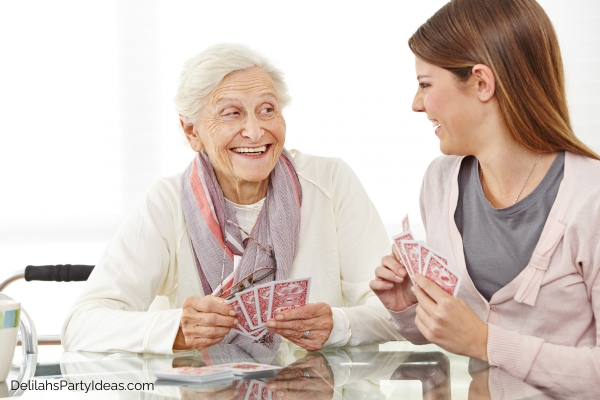
Good old Snap is perfect because the rules are simple, the pace can be adjusted, and it gets people laughing. Use a large-print card deck if vision is an issue. You can play a very gentle version where you simply take turns turning cards over and calling “Snap!” when two match, with no time pressure at all.
Go Fish
Go Fish works well in the early to middle stages of dementia because the repeated question “Do you have a…?” gives plenty of prompts and structure. Use a large-print deck and keep the hand size small (three or four cards). Don’t worry about strict rules. The social back-and-forth is the real game here.
Dominoes
Matching dominoes is a tactile, visual activity that many seniors have played their whole lives. The act of touching and sorting the tiles is satisfying even before the game begins. Play a simplified version where you simply match ends without worrying about scoring, and enjoy the process of building the chain together.
Uno (Simplified)
Strip Uno back to just matching colors or numbers and you have a beautifully simple matching game. Remove the action cards if they add confusion and just enjoy the rhythm of playing a card, drawing a card, taking turns. The bright colors make it visually engaging and easy to follow.
Movement and Active Games
Gentle physical activity is fantastic for people with dementia. It improves mood, supports circulation, and provides a lovely sense of accomplishment. These games are all low-impact and can be done seated if needed.
Balloon Volleyball
Blow up a balloon and bat it back and forth across a table or between chairs. It’s endlessly playful, completely safe, and gets everyone giggling. The slow movement of the balloon gives plenty of reaction time, making it ideal even for those with limited mobility. You can add a simple net made from a piece of string across the table if you want to make it feel more official.
Beanbag Toss
Set up a simple target (a bucket, a hoop, or even just a piece of tape on the floor) and take turns tossing beanbags. Adjust the distance based on ability and celebrate every toss, not just the ones that land in the target. This game builds hand-eye coordination and feels genuinely rewarding when someone gets it right.
Bowling (Tabletop Version)
Set up lightweight plastic bottles or soft skittles at one end of a table and roll a soft ball toward them. Tabletop bowling is great because it requires minimal setup, can be played from a seated position, and gives people a clear goal to aim for. Cheer loudly for every knock-down and reset cheerfully for the next turn.
Creative and Art-Based Games
Creative activities tap into a different part of the brain and often feel freeing for people with dementia. There’s no right or wrong, which takes all the pressure off.
Coloring Pages
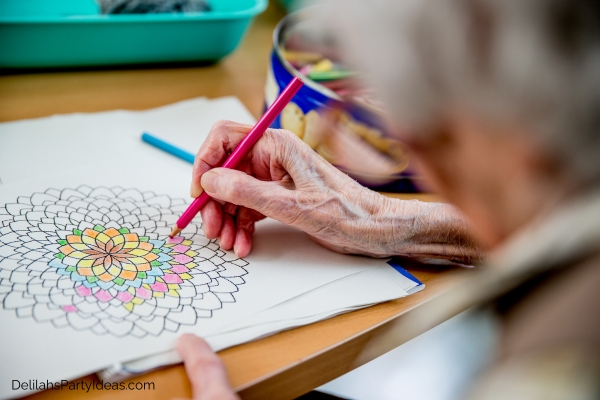
Large, simple coloring pages are wonderfully calming and give people a sense of completion and pride. Choose designs that reflect their interests: flowers, animals, classic cars, birds. Sit together and color alongside them to make it a social activity rather than something they do alone. The finished page makes a lovely keepsake too.
Collage Making
Cut out pictures from old magazines and let your person choose images they like and glue them onto a piece of card. You can give it a gentle theme (gardens, animals, food, travel) or leave it completely open. The act of choosing, handling, and arranging images is engaging and satisfying, and the result is something they can be proud of.
Simple Painting
Set up a canvas or thick paper with a few pots of washable paint and wide brushes and let them paint whatever they feel like. Abstract is absolutely fine. Focus on the process, not the product. Music in the background, a cup of tea nearby, and plenty of encouragement makes this a lovely, relaxed activity.
Tips for Running These Games Smoothly
Keep it short and sweet: Most people with dementia do best with activities that last 15 to 30 minutes. Watch for signs of tiredness or frustration and be ready to wrap up gently and positively before that point.
Follow their lead: If a game isn’t landing, don’t push it. Switch to something else without any fuss. Their engagement on any given day depends on so many factors, including how they’re feeling, the time of day, and what else has happened.
Make it social: Games are more enjoyable when you’re playing alongside someone. Sit with them, make eye contact, smile, and respond warmly to whatever they say or do. Your presence is as important as the activity itself.
Celebrate everything: Praise every effort, not just successes. “You did so well!” and “Look at that!” go a long way toward building confidence and keeping the atmosphere light and positive.
Use familiar objects: Games that involve objects your person already knows and loves (old coins, fabric scraps, playing cards they’ve used for years) tend to feel more comfortable and less confusing than brand-new materials.
Finding the right games for seniors with dementia takes a little trial and error, but once you land on the ones that spark joy, they’ll become your go-to toolkit for beautiful, connected moments together. You’re doing something really wonderful by putting this time and care in, and that matters more than you know.